



Build ERP from Scratch or Buy Boxed ERP
Build ERP from Scratch or Buy a Boxed Product: How to Avoid Crushing Unique Processes with Standard Software helps businesses choose the right ERP strategy without damaging workflows that make them competitive. This guide covers planning, examples, benefits, common mistakes and best practices for comparing boxed systems with custom ERP development. You will learn when standard software is enough, when unique processes require tailored logic, and how ERP implementation and ERP integration with CRM, accounting, inventory and internal tools can support scalable operations instead of forcing the business into rigid templates.
Introduction: When Your Business No Longer Fits Inside a Standard ERP
You tried to implement 1C:ERP, SAP, or another off-the-shelf platform, only to discover that your critical processes, such as custom production, complex logistics, or a non-standard incentive model, do not fit into typical directories and documents. Modifications are expensive, slow down updates, and eventually turn the system into a patchwork of compromises. In this article, we explain the situations in which custom ERP development stops being a luxury and becomes the only economically sound option.
Section 1: Five Signs You Need ERP Development from Scratch
- A unique value-creation chain. For example, you manufacture equipment to individual drawings, with floating costs for every single unit. Standard ERP systems struggle to calculate such orders correctly.
- An industry with strict specifics. Aviation, pharmaceuticals, and defence all require traceability and documentation workflows that standard ERP products do not provide out of the box.
- A complex role model and organisational structure. Matrix management, dynamic working groups, and cross-functional processes that go far beyond the usual "Purchasing-Production-Sales" framework.
- Plans for rapid scaling. If you want to enter international markets within two years, with multicurrency accounting and multiple jurisdictions, endless modifications of a boxed solution will become a bottleneck.
- A strategy of digital independence. You do not want your core operations to depend on the policies of a third-party vendor, especially a foreign one.
Section 2: Total Cost of Ownership, Boxed ERP with Modifications vs Custom ERP
Many people assume that building from scratch is always more expensive. But let us look at the five-year horizon:
| Cost item | Off-the-Shelf ERP (1C ERP) | Custom ERP |
|---|---|---|
| Licences | RUB 300,000 to 1,500,000 | 0 |
| Implementation and modifications | RUB 2,000,000 to 10,000,000 | RUB 3,000,000 to 15,000,000 for MVP development |
| Support and development over 5 years | RUB 1,000,000 to 5,000,000 | RUB 800,000 to 3,000,000 with an internal team or our service model |
| Updates and compatibility | High risk of breaking modifications with every vendor release, plus retesting costs | Updates are planned, and the architecture is designed as modular from day one |
Conclusion: when the amount of specialised customisation becomes large, a custom ERP can be cheaper in the long term.
Section 3: Our ERP Development Approach, We Start with Business Analysis, Not Code
Eighty percent of ERP project failures happen because the requirements were analysed poorly. We prevent that through a structured approach:
- Discovery phase, 2-4 weeks. We conduct a series of interviews with process owners and map both the current and target process landscapes.
- Vision and technical specification. We define the architecture, functional modules, and integrations, then align priorities.
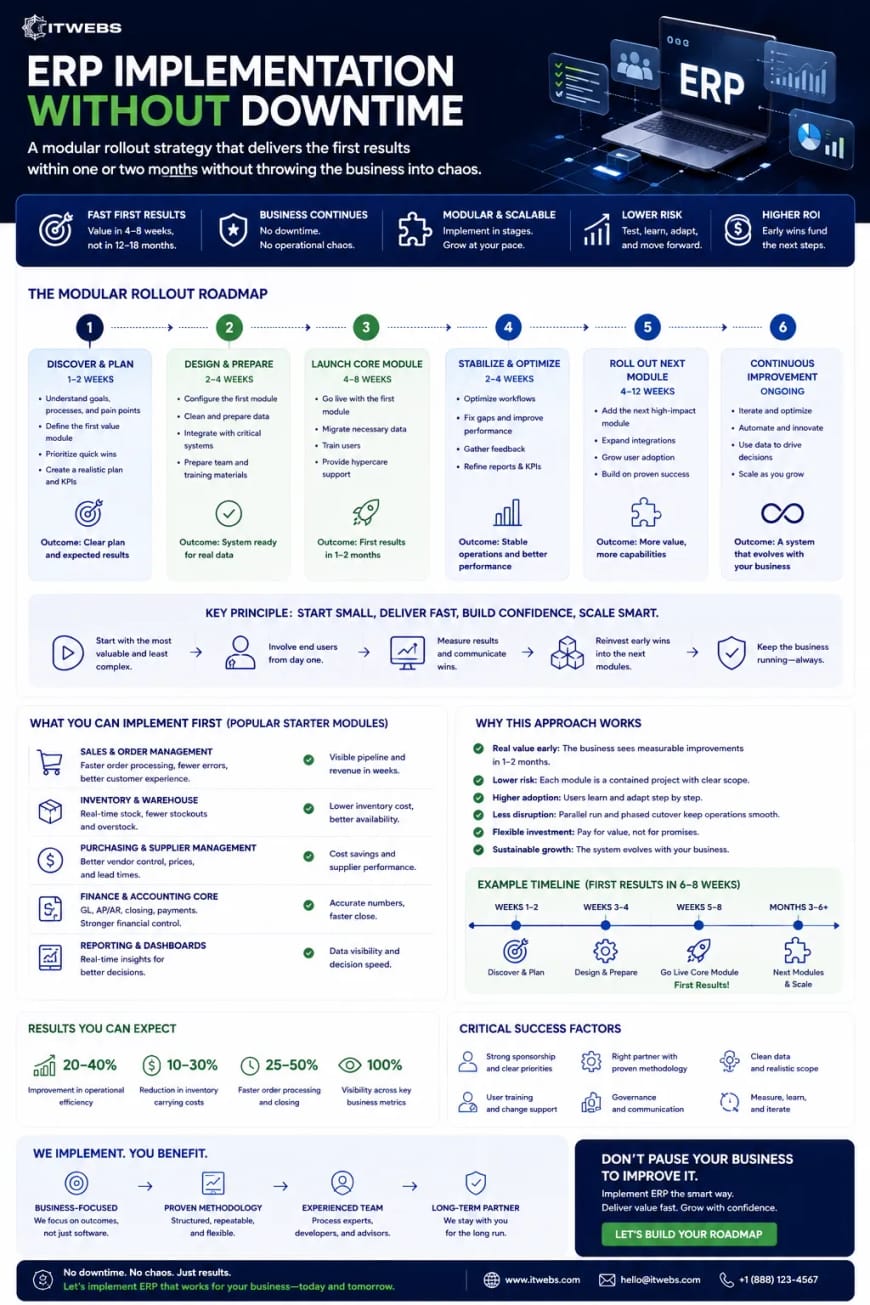
- Phased development and rollout. We begin with the most business-critical module, for example production accounting, launch it in one plant or department, and only then automate the remaining areas. For more on this method, see our article on implementing ERP without business downtime.
Section 4: Myths About Custom ERP
- "It takes years." An MVP that solves your core pain point can usually be delivered in 4-6 months. The system can then evolve iteratively.
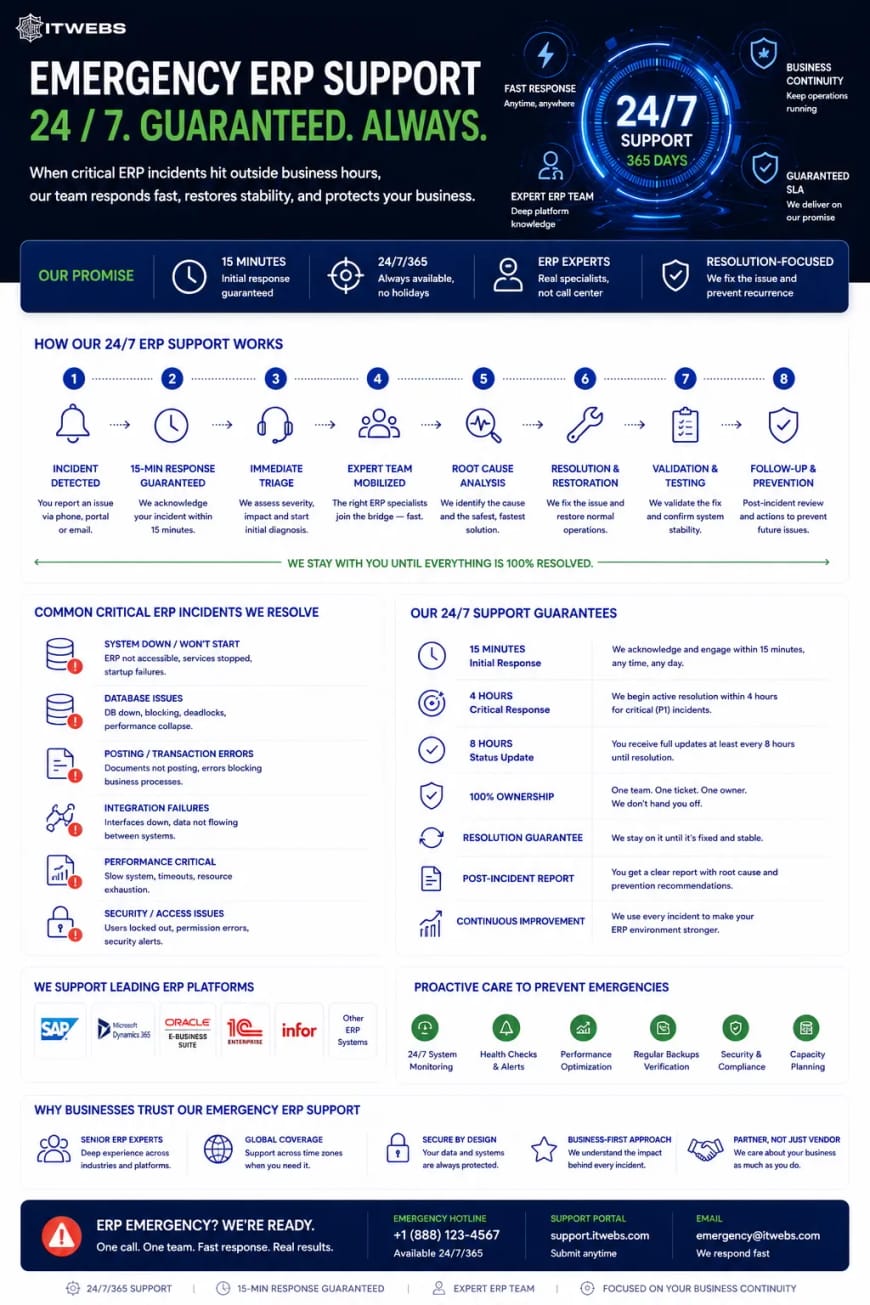
- "We will be left without support." We support the systems we build on a 24/7 basis. You are not dependent on a single developer.
- "It will not integrate with anything." We build ERP around open APIs, so connecting banks, logistics providers, or product marking systems is a standard task.
Conclusion: The Right ERP Adapts to the Business Instead of Breaking It
The real choice between a boxed ERP and a custom one is a choice between adapting your processes to software or creating software that mirrors your business model. If your model is unique and creates competitive advantage, it should not be sacrificed for short-term savings.
Not sure which route makes sense for you?
We can run a technology audit and model two scenarios: modernising your current system or building a new one. You will get a roadmap and a financial model to support the decision.