



Mini App vs Native Mobile App
Mini App vs Native: How to Reach the Market Three Times Faster at Half the Cost explains when a business should choose a mini app instead of full native development. This article compares mini app vs native, the difference between mini app and native mobile app, launch speed, budget logic and user access. You will learn the key advantages for mini app, when to choose mobile application or mini app, and how Telegram Mini App development can help validate ideas faster. Use this guide to understand how a mini app for business can reduce risk, shorten time to market and support scalable digital growth.
Introduction: The Platform Choice That Determines Your Budget and Speed
Before launching a digital product, every business faces a core decision: build a native mobile app for iOS and Android, use cross-platform tools, or increasingly, launch a Telegram Mini App. A mistake at this stage can cost millions and months of lost time. In this article, we offer an honest comparison so you can make a grounded decision.
Section 1: Comparison Table of Technical and Business Characteristics
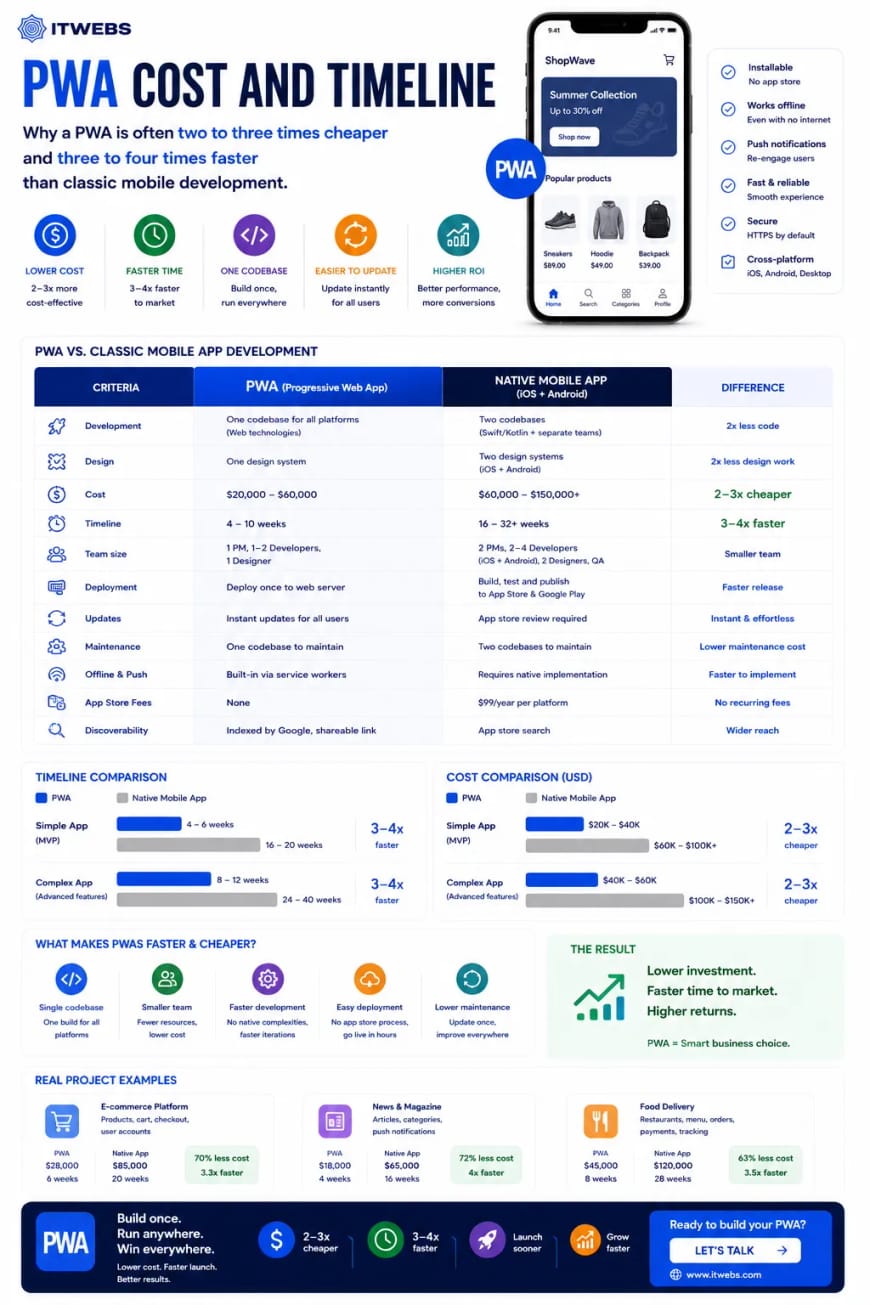
| Criterion | Telegram Mini App | Native mobile app |
|---|---|---|
| MVP development time | 2-5 weeks | 3-6 months for iOS and Android |
| MVP budget | RUB 300,000 to 800,000 | RUB 2,500,000 to 8,000,000 |
| User installation | Not required, opens by link | Required via app marketplace |
| Reach | All Telegram users, 900M+ | All smartphone users through marketplaces |
| Push notifications | Via bot | Native rich notifications |
| Device hardware access | Limited, for example camera and geolocation | Full, including Bluetooth, NFC, and sensors |
| Offline mode | Limited caching | Full |
| Payments | Built in, via Telegram Stars and Payments | In-app purchase, Apple Pay, Google Pay |
Section 2: When a Mini App Is the Obvious Choice
- MVP and hypothesis validation. If you want to test demand for a new service quickly without major upfront investment.
- Loyalty programmes and customer accounts. When you want to give existing clients easy access to bonuses, history, and orders.
- Services for immediate needs: booking, delivery, and online appointments. If the main usage pattern lasts just a few minutes, forcing installation makes little sense.
- Businesses whose core audience already lives in Telegram: info products, bloggers, and niche communities.
Section 3: When You Cannot Avoid a Native App
- Heavy on-device computing. Video editors, 3D games, or products with real-time AI photo processing.
- Deep hardware integration. Fitness trackers with constant sensor data capture, IoT applications using BLE or Bluetooth, and banking apps with NFC payments.
- Maximum security and isolation requirements. Mini Apps are secure enough for many cases, but native apps with local data encryption provide more control.
- A world-class product defined by unique UX. If your key competitive edge is custom animation, micro-interaction design, and maximum fluidity, native development will perform better.
Section 4: Our Recommended Route, Start with a Telegram Mini App, Move to Native Only If Needed
We often recommend a staged strategy: launch a Mini App first, gather an initial user base, test the feature set and business model, and then decide whether native development is justified based on real metrics such as LTV, retention, and acquisition cost. This lowers risk and lets you invest more budget in growth instead of code that may turn out to be unnecessary.
Conclusion: There Is No Universally Best Platform, Only the Right Platform for the Task
The choice between a Mini App and a native app is a choice between speed and depth. Do not let stereotypes push you into funding development your users do not actually need at this stage.
Not sure where to start with your product?
Book a strategy session. We will analyse your business model and target audience and provide a recommendation you can act on.