



Web Portals and Platforms for Business
Web Portals and Platforms: When a Business Needs More Than a Website explains how companies can move beyond a standard corporate site when they need client accounts, internal tools, automation, integrations or scalable digital services. This guide covers strategy, planning, examples, benefits, common mistakes and best practices for choosing between a website, portal or full platform. You will learn how custom website development, web development strategy and website conversion optimization support more complex digital ecosystems that improve operations, customer experience and long-term business growth.
Introduction: If Your Business Is More Than Buy-and-Sell, a Brochure Site Is No Longer Enough
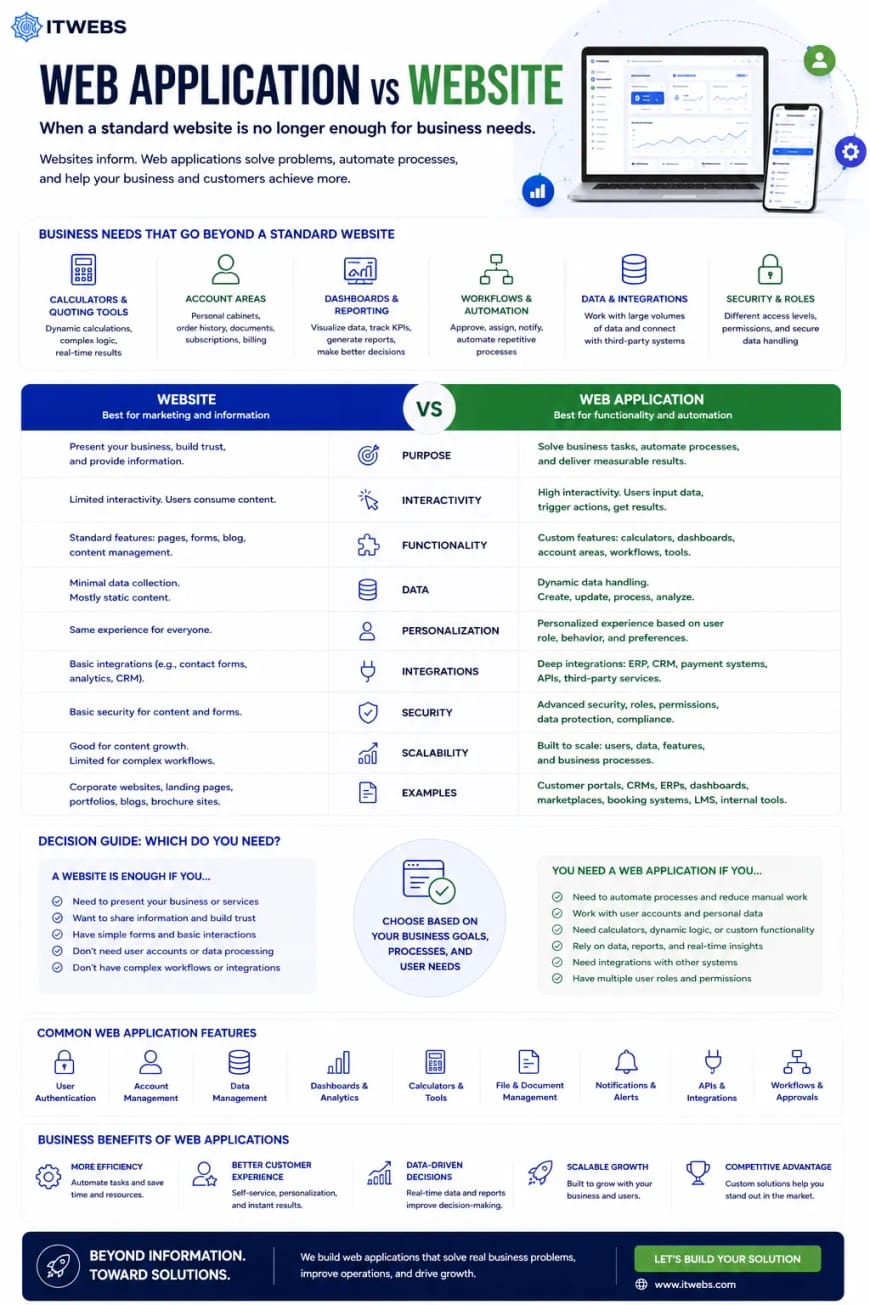
Once your company has partners, dealers, branches, and a complex hierarchy of access, a corporate website turns into a portal. That means more than just more pages. It becomes a full platform with roles, multiple types of personal accounts, internal document workflows, and BI analytics. Recognising that you need a portal early is how you avoid losing control as the business grows.
Section 1: Three Key Differences Between a Portal and a Website
- Role-based access, RBAC. A website may have an admin and a user. A portal may have dozens of roles, client, client manager, partner, supervisor, accountant, each with a different interface and permission set.
- Multiple account experiences. A B2B client sees purchase pricing, shipment history, and invoices. An employee sees KPI data, tasks, and internal documents. All of this exists within one system.
- End-to-end business processes. Contract approval, warehouse requests, escalation of issues, all can be automated and managed through the portal.
Section 2: When a Portal Becomes Necessary
- You have more than 50 active dealers or partners who need personalised access to prices and documents.
- Internal document workflows, reports, or service notes are getting out of control in email.
- You need a unified interface for managing multiple branches with consolidated data.
Section 3: How We Build Portals
We design modular, microservice-based systems: an authentication and roles core, sales module, warehouse module, and BI module. We launch an MVP for one user group first and then add functionality step by step. This allows you to get quick results without paralysing the business.
Section 4: Example, a B2B Portal for an Auto Parts Distributor
We created a portal where 2,000 service stations can order spare parts, see personal discounts, track delivery, and exchange documents. Turnover through the portal grew by 40% in a year, while order errors were reduced threefold.
Conclusion: A Portal Is the Digital Nerve System of Your Company
It connects clients, partners, and employees in one environment, speeds up processes, and gathers the data you need to manage growth.
Feel like your business has outgrown a simple website? Invite us to a free strategy session, and we will help define the right architecture for you.