



What Online Store Websites Need to Convert
What an Online Store Website Must Include explains how ecommerce businesses can create a shopping experience that builds trust, reduces friction and increases sales. This guide covers strategy, planning, examples, benefits, common mistakes and best practices for building an online store that supports real customer decisions. You will learn how custom website development, web development strategy, website conversion optimizationand ecommerce website development help structure product pages, categories, filters, checkout, payments, delivery logic, reviews and SEO foundations for scalable online growth.
Introduction: An online store is not a catalogue. It is a sales machine. Why do so many stores lose money on every visitor?
People do not visit an online store to admire its design. They arrive with a clear need: find a product, compare options, buy with confidence, and receive the order without friction. If friction appears at any point, through weak search, missing reviews, forced registration, or a confusing checkout, the customer leaves. In modern e-commerce, competition is driven by convenience, speed, and trust. Your store needs to work like a disciplined engine that helps the user buy rather than forcing them to struggle through the process.
Many business owners still think of an online store as a catalogue with a cart. In reality, it is your primary sales channel, support desk, and digital storefront all at once. This article answers a simple but critical question: what should an online store website include if it is meant to convert traffic into orders and visitors into loyal customers?
Block 1: The essential structure of a modern online store
- Homepage: navigation, positioning, and trust in the first seconds
- A clear header with category navigation, smart search, cart, and account access.
- A strong promotional banner or value proposition such as free delivery thresholds or current seasonal offers.
- Visible category blocks, featured products, promotions, and trust signals around payments and delivery.
- Catalogue with intelligent filtering
- Categories should move from general to specific and support practical filters such as price, brand, size, colour, and technical attributes that matter to the buyer.
- Sorting, display toggles, and adaptive layouts should all help users find the right item faster.
- Product page: the core sales page
- High-quality visuals from multiple angles, ideally including video and zoom.
- Clear product naming, SKU, pricing, stock information, delivery options, and a strong primary purchase action.
- Detailed descriptions, structured specifications, customer reviews, ratings, and relevant upsell or related-product blocks.
- Cart and checkout
- Customers should be able to review the order easily, apply promo codes, change quantities, and complete the purchase on one page whenever possible.
- Checkout should support guest purchase, transparent delivery pricing, payment choice, and a clear final summary.
- Customer account area
- This should include order history, reorder options, profile editing, saved favourites, and ideally a visible loyalty or bonus mechanism.
- Service and trust pages
- Delivery, payment, returns, guarantees, company information, and contact details must all be clear, accessible, and commercially reassuring.
- Blog or buying guide section
- Educational content helps customers choose correctly and also attracts valuable search traffic.
Block 2: Critical functionality for conversion and retention
- Smart on-site search with suggestions and typo tolerance.
- Buy-in-one-click flow for fast mobile or high-intent purchases.
- Ajax or mini-cart behaviour so customers do not lose context every time they add a product.
- Online chat for quick reassurance and product questions.
- Delivery integrations that calculate timing and cost automatically.
- Mobile-first performance and ideally PWA support for stronger mobile commerce.
- Remarketing logic for abandoned carts and return visits.
Block 3: Content and commercial mechanics that increase sales
- Social proof
- Verified reviews, photos from real buyers, visible product popularity, and seller ratings all support trust.
- Purchase incentives
- Timed promotions, loyalty discounts, bonuses, and campaign messaging can all lift urgency and basket value.
- Live or near-live cues
- Messages such as low stock or recent purchases should be used carefully to reinforce action, not manipulate users blindly.
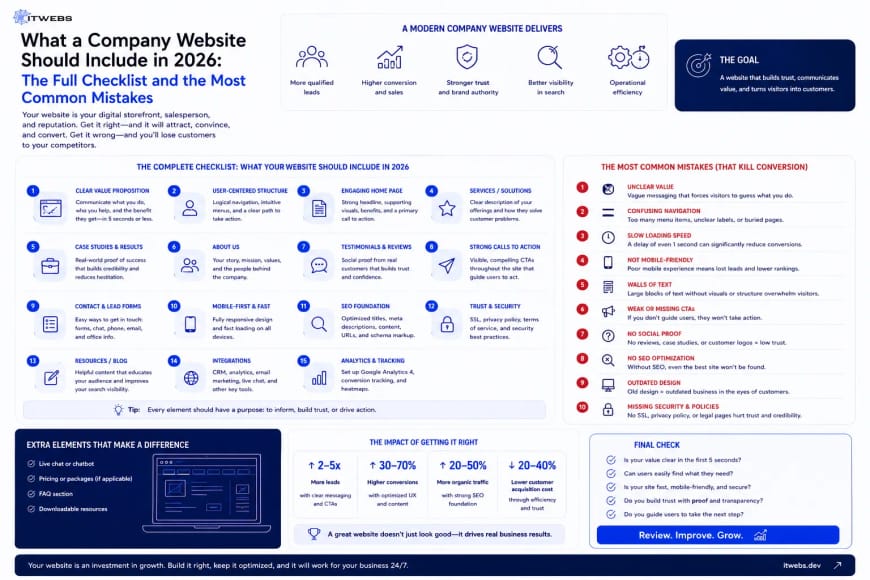
Block 4: Fatal mistakes online stores keep making
- Complicated registration before checkout.
- Hidden delivery cost until the last step.
- No visible phone number or support channel.
- Poor loading speed, especially for product imagery.
- A weak mobile experience.
- A confusing or untrusted return policy.
- Unexpected fees appearing at payment stage.
Conclusion: An online store is a system that must be improved continuously
Every detail on an e-commerce site, from page speed to the wording on the checkout button, affects conversion. Building an online store is not a one-time project. It is an ongoing process of analysis, testing, and optimisation.
If you implement the structure and functionality outlined above, you will create a much stronger commercial foundation. But the real competitive advantage in 2025 and 2026 comes from personalisation, speed, and a seamless user experience across every device.
Want to know how effective your current store really is?
We offer a free e-commerce audit covering usability, conversion flow, technical performance, and SEO readiness, followed by a prioritised plan for sales growth.