



Why Your Business Needs a PWA
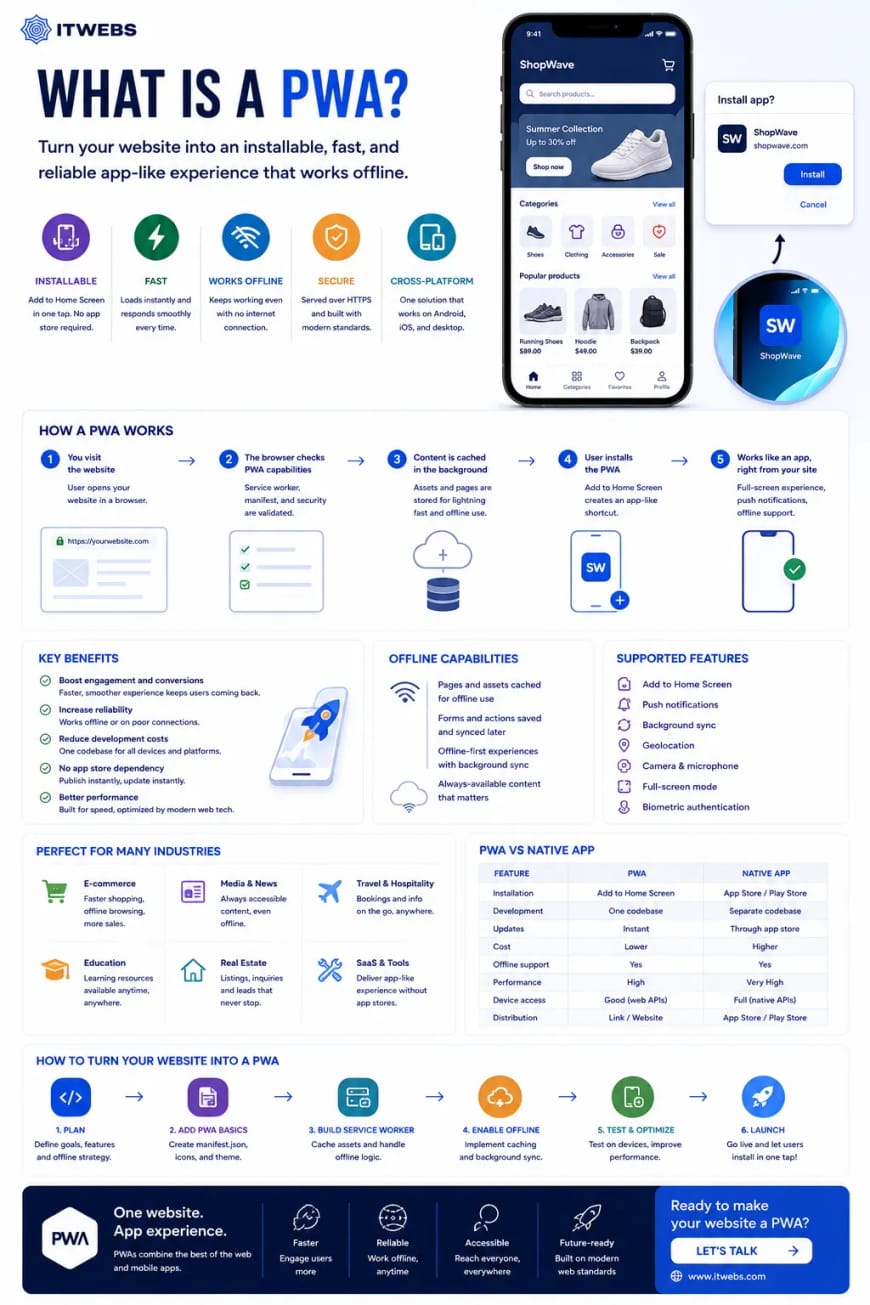
A progressive web app can help businesses keep mobile visitors engaged when a standard website feels slow, limited or inconvenient. This article explains what a PWA app is, how a progressive web application works and why progressive web app development can improve speed, usability and return visits. You will learn the key advantages of progressive web app solutions, benefits of progressive web apps, PWA examples and when to build progressive web app functionality for business. Use these insights to understand how PWA development, custom web development and mobile PWA strategy can turn lost traffic into loyal users.
Introduction: You Have Mobile Traffic but Not Mobile Sales. Why?
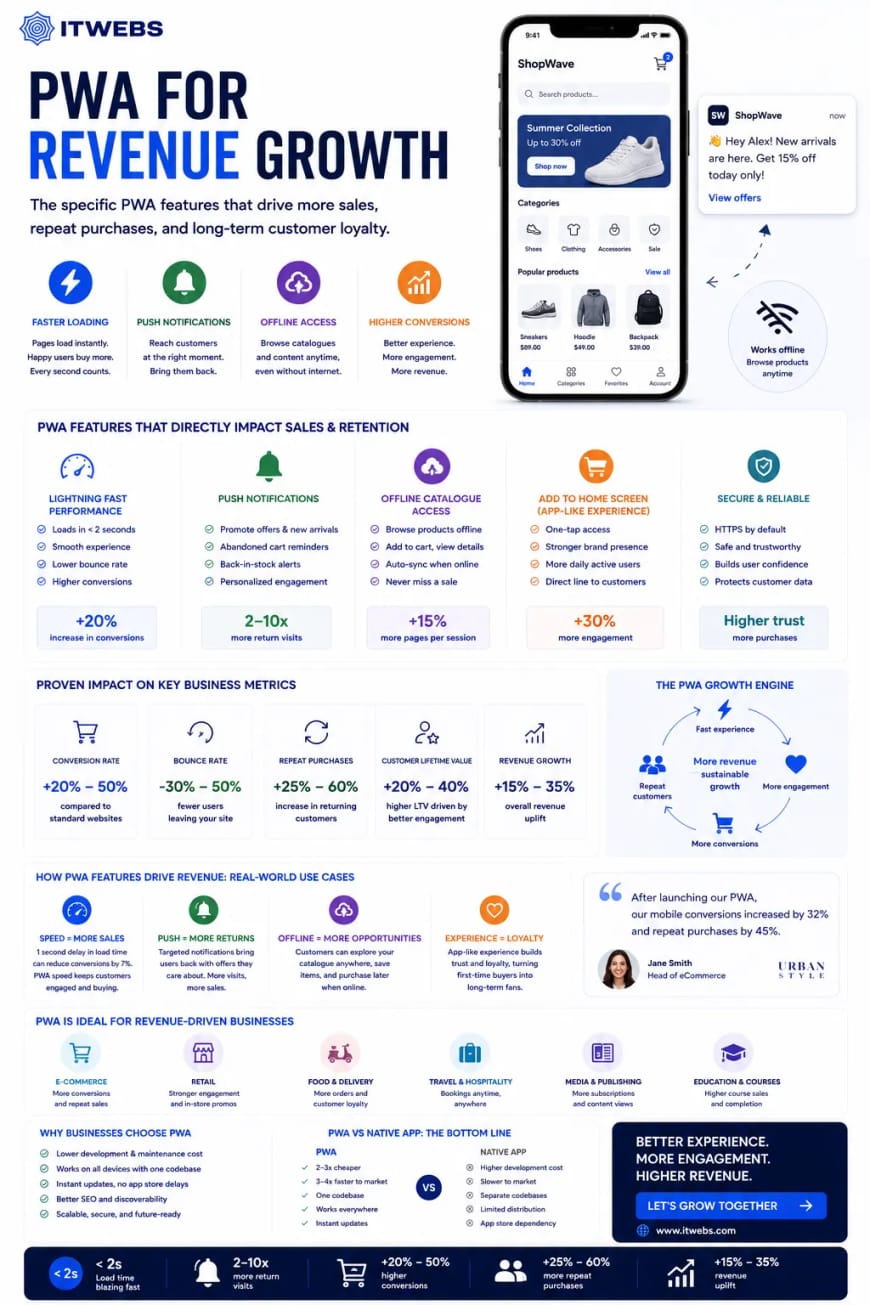
Average conversion on mobile websites is still 2-3 times lower than on desktop. The issue is not that people do not want to buy on their phones. The real problem is slow loading, awkward navigation, and data loss when the connection drops. PWA removes these barriers and closes the gap between a website and an app. Let us compare the numbers.
Section 1: Key Metrics, Standard Mobile Website vs PWA
| Metric | Standard responsive website | PWA |
|---|---|---|
| Load speed on 3G | 4-8 seconds | 0.5-1.5 seconds |
| Bounce rate | 45-60% | 20-35% |
| Order conversion rate | 0.5-1.5% | 1.5-3.5% |
| Repeat visits | Driven by bookmarks and memory | 30-50% higher thanks to icon and push |
| Offline functionality | Impossible | Partial or full, depending on implementation |
Section 2: Three Situations Where PWA Clearly Outperforms a Standard Website
- A user on the move with unstable internet. Standard site: endless loading, white screen, user leaves. PWA: shows the cached catalogue, lets the user add items to the basket, and syncs once the connection returns. The sale is not lost.
- Bringing the customer back with push notifications. Standard site: you hope the user remembers to return. PWA: once the user consents, you can send push alerts about price drops or back-in-stock items. Re-engagement costs far less than social media retargeting.
- One-tap access from the home screen. A PWA icon among mobile apps acts as a permanent reminder. Opening that "app," which is still your site under the hood, is faster than typing your URL into a browser.
Section 3: PWA's Impact on SEO and Content Marketing
A PWA is still your website, which means all product pages, articles, and category pages remain indexable by search engines. You do not lose organic traffic the way you often do with a shift to a native app. More than that, Google ranks fast websites with strong user experience, measured through Core Web Vitals, higher. PWA improves these metrics significantly and can strengthen search visibility.
Section 4: When PWA May Not Be Enough, and That Is the Honest Part
- iOS still has limitations. Safari on iOS now supports push notifications, but Service Worker behaviour has historically been more limited than on Android, and some features such as background sync remain less reliable.
- Very high security requirements. Banks and fintech companies may still prefer native apps, even though PWA can also be built to a very high security standard.
Conclusion: Moving to PWA Is the Fastest and Most Affordable Way to Improve Mobile Sales
You can keep losing mobile customers, or you can make your site as fast and convenient as an app. The second path does not require millions in budget or months of development.
Find out how much you are losing right now. Order a free PWA audit of your website. We will measure your current metrics and estimate the likely conversion uplift after implementation.