



Why Business Needs a Digital Ecosystem
Why Business Needs an Ecosystem: Client Portal, Mobile App, Chatbot, and CRM Working as One explains how connected digital tools create stronger customer experience, faster operations and better sales control. This guide covers strategy, planning, examples, benefits, common mistakes and best practices for building a business ecosystem around a client portal, mobile app, chatbot and CRM implementation. You will also learn how custom website development, web development strategy and website conversion optimization help turn separate tools into one scalable digital infrastructure for business growth.
Introduction: Why a "Zoo" of Digital Tools Damages Your Business
Your website was built by one studio, the CRM by another, a freelancer created the chatbot, and the mobile app was developed in-house as an experiment. Sound familiar? The result is predictable: the client sees one price on the website, another in the app, and the manager in the CRM knows nothing about the order placed through the chatbot. This does not just create frustration, it destroys trust and reduces profit. The solution is a single IT ecosystem in which every component works from the same logic and the same data foundation. In this article, we explain what that means and why our single-contractor approach solves the problem.
Section 1: What We Mean by a Business Digital Ecosystem
This is not simply "a website plus an app." It is an interconnected environment where:
- The personal account on the website and in the mobile app is the same system, just presented through different interfaces connected to one backend.
- The CRM acts as the central hub for every request from every channel, including the website, chatbot, Telegram Mini App, and phone calls.
- The chatbot is not a standalone tool, but another interface that understands the client's history because it reads from the CRM.
- The accounting system, such as 1C, is synchronised with the ecosystem core so that stock, pricing, and order statuses are updated in real time across all channels.
The core principle: a Single Source of Truth. If a client changes their phone number in their account, the update instantly appears in the CRM and is recognised by the chatbot as well.
Section 2: Ecosystem Architecture, How It Works Technically
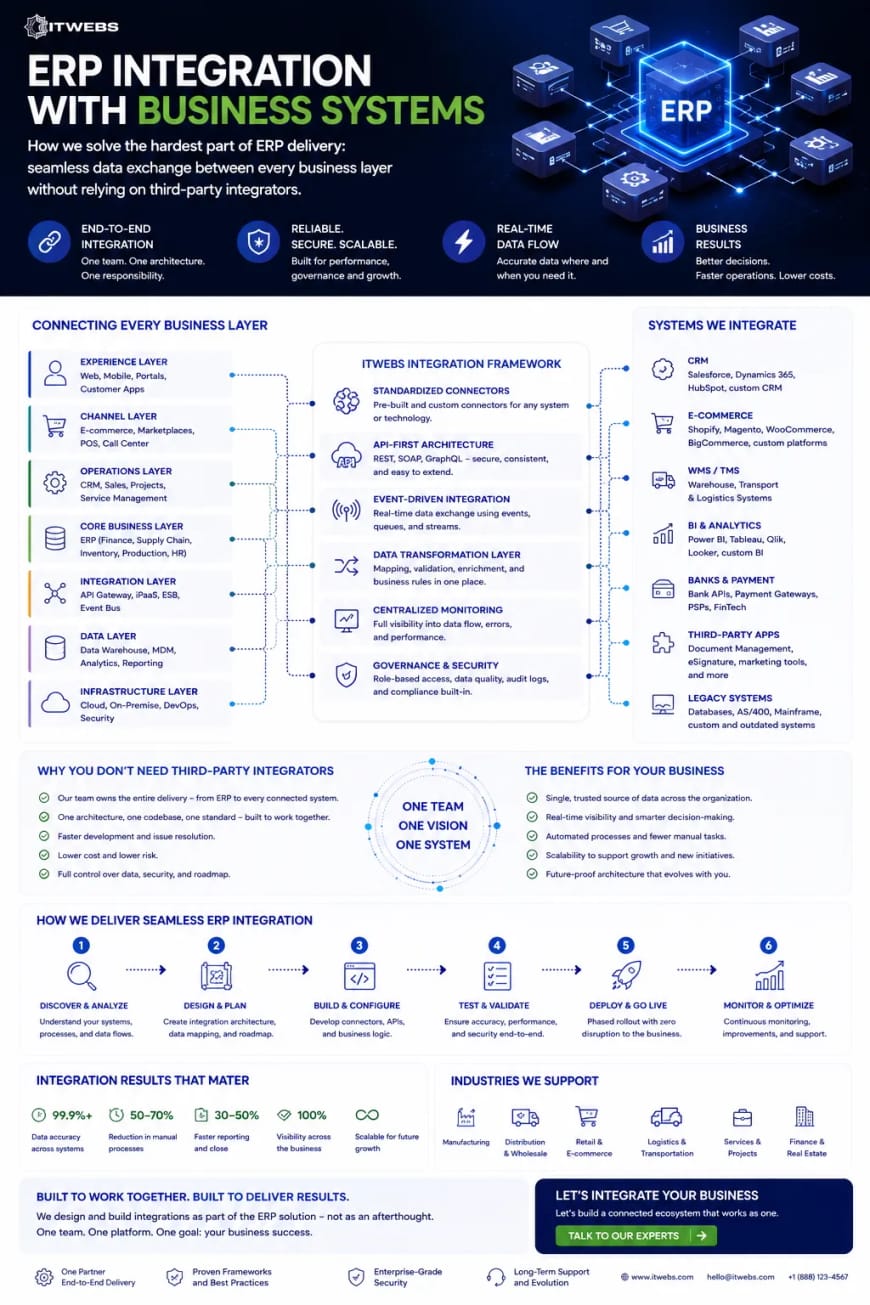
We build ecosystems around an API-first core. This means that all business functionality, including authentication, order processing, pricing, and loyalty logic, lives inside one central backend. The website, mobile app, and chatbot become lightweight clients that interact with the core through APIs. This gives you:
- Consistency: business logic is not duplicated, which prevents discrepancies in calculations, discounts, or promotion rules.
- Flexibility: adding a new channel, such as a PWA or voice assistant, usually means building a new interface while the core remains intact.
- Security: personal data is stored in one protected environment instead of being scattered across tools built by multiple contractors.
Section 3: Business Benefits, in Real Numbers
- True omnichannel continuity. A customer starts an order in a chatbot, leaves it unfinished, and opens the app an hour later to find the same cart waiting there. This kind of continuity can lift conversion by 15-25%.
- Lower support costs. You do not need to reconcile three databases or investigate why the app shows the wrong order status. One system means one support team.
- Faster innovation. Want to launch a cashback-based loyalty programme? It can work on the website, in the app, and in a Telegram Mini App immediately, because the feature lives at the core level.
Section 4: Why Working with One Contractor Is Critical
The biggest mistake in ecosystem projects is handing different parts to different teams. The result is a patchwork architecture built on fragile integrations. We work as one team that designs the whole system as a single product.
How we run such projects:
- Business analysis and architecture. We map the entire ecosystem, define the core, and agree the API contracts.
- Development of the core MVP and one priority client interface, for example the personal account.
- Step-by-step connection of the remaining channels, such as the mobile app and chatbot, without stopping the already working MVP.
- 24/7 support for the entire ecosystem under one SLA.
Conclusion: An Ecosystem Is Not an IT Project, It Is a Strategic Asset
Building a unified digital operating environment creates the foundation for scaling. You stop depending on the limits of isolated platforms and gain full control over your data and customer experience.
Want to move from disconnected tools to a coordinated ecosystem?
We offer a strategy session where we can design the architecture of your future system together and build a six-month roadmap.