



ERP Integration Across Business Systems
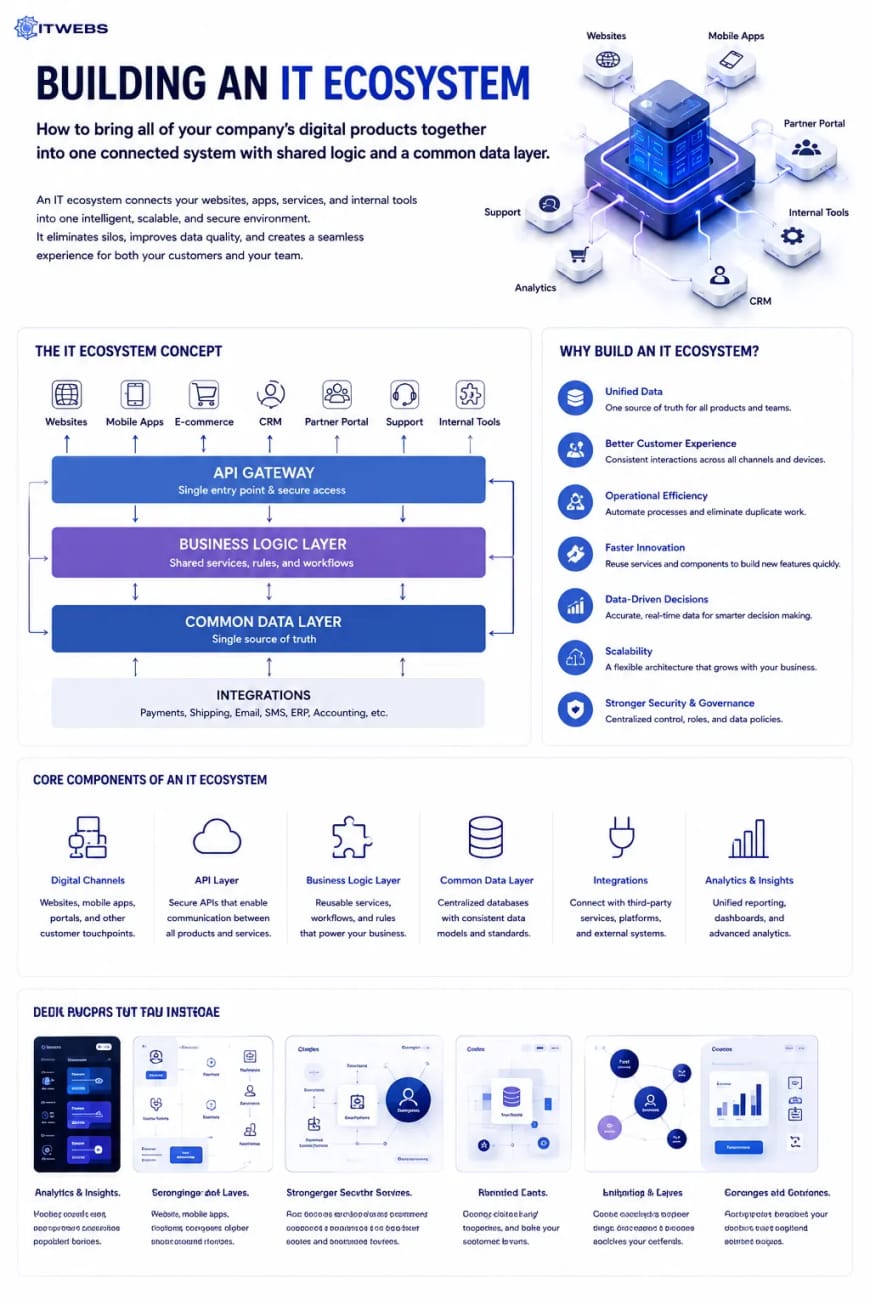
ERP Integration with Website, CRM, and Equipment: Stop Playing Broken Telephone Across the Businessexplains how connected systems help companies reduce manual data transfer, duplicated work and operational mistakes. This guide covers strategy, planning, examples, benefits, common mistakes and best practices for building reliable business workflows through ERP integration. You will learn how custom website development, web development strategy, website conversion optimization and CRM implementation support a connected digital ecosystem where website requests, customer data, equipment signals and ERP processes work as one scalable business infrastructure.
Introduction: Why the IT Equivalent of Chinese Whispers Steals Your Profit
A client places an order, but the warehouse cannot see it. A manager issues an invoice, but accounting does not know the payment has arrived. A machine receives a production task, but the order status in the CRM is never updated. These are classic symptoms of missing end-to-end integration between ERP and the rest of your systems. The cost of such disconnects is real: lost clients, frozen stock, and poor management decisions. In this article, we show how we connect the ERP core with your website, CRM, telephony, and even production equipment into one living operational system.
Section 1: The Key ERP Integration Points and Why File-Based Patching Is Not Enough
- Website, B2B or B2C portal, and ERP.
- Live stock and pricing: the customer sees real availability and a personalised price calculated by ERP.
- Order to production or warehouse: once an order is placed, ERP immediately reserves stock or creates a production order.
- CRM and ERP.
- The systems coordinate commercial terms and credit limits. A CRM user cannot issue an invoice if ERP reports overdue receivables.
- After a shipment is completed in ERP, the CRM automatically receives the "Fulfilled" status and launches the post-sales workflow.
- Equipment, IoT devices, handheld terminals, and ERP.
- A warehouse scanner reads a barcode, ERP writes off the item, and the website stock level is updated in 0.5 seconds.
- A CNC machine sends operation data to ERP for payroll calculation and actual cost accounting.
Section 2: Case Study, ERP, Website, and Production Line Integration for a Furniture Factory
Problem: dealers ordered kitchens through the website, but managers had to check production capacity manually and recalculate the final cost. Confirming an order could take up to three days, and some orders were lost entirely.
Solution:
- We developed an API gateway between the website, our custom ERP, and the manufacturing execution system, MES.
- The dealer configures the kitchen on the website, the website requests available production slots from ERP via API, ERP reserves the slot and returns the final price, the dealer confirms the order, and ERP creates a shift task in MES.
Result: order confirmation time dropped to two minutes. Order volume increased by 30% thanks to the smoother experience, and production errors decreased by 15%.
Section 3: The Technical Architecture We Use
We do not connect systems directly in brittle point-to-point chains. Our architecture is based on:
- A central data bus, Apache Kafka or RabbitMQ. Every event, such as "order created" or "payment received," enters the bus, and each system subscribes only to the event types it needs. This guarantees data delivery and makes it easy to connect new systems later.
- Microservice adapters. For every external system, whether 1C, the website, or equipment, we build a dedicated microservice that understands its API and business logic. If 1C changes version, only that adapter needs updating.
- Flow monitoring. A real-time dashboard shows the number of processed events, delays, and errors. We see problems before the business reports them.
Section 4: Why We Do Not Bring in External Integrators
When multiple teams handle different parts of integration, you get a technical zoo: different approaches, different logs, different documentation, and no single owner of the outcome. As one contractor, we develop both the ERP core and the adapters around it. Responsibility for the full chain stays with us. You get one 24/7 support window and an SLA for the whole ecosystem, not for isolated connection points.
Conclusion: Integration Is Not Back-Office Plumbing, It Is the Nervous System of the Business
The speed and accuracy of data exchange between ERP, your website, CRM, and equipment translate directly into faster customer service, better inventory turnover, and stronger management decisions.
Does it feel like your systems are all living separate lives?
We can conduct an audit of your IT landscape and design a seamless integration plan tailored to your business.