



Why Online Stores Need Custom Development
An Online Store Should Not Be a Template: Why Your E-Commerce Brand Deserves Custom Developmentexplains why standard ecommerce layouts often limit conversion, SEO and long-term growth. This guide covers strategy, planning, examples, benefits, common mistakes and best practices for building an online store around real customer behaviour and business processes. You will learn how ecommerce website development, online store SEO and ecommerce automation help create a scalable shopping experience with stronger UX, cleaner operations and better sales potential.
Introduction: Insales, Shopify, and WooCommerce Are Great Until You Hit Their Limits
At the start of an online store, a boxed solution is often the logical choice. But once you need complex discount rules, integration with a unique stock system, non-standard logistics, and support for thousands of products, ready-made platforms begin to slow you down. You end up spending budget on workarounds that do not solve the real problem. Custom e-commerce development gives you freedom and long-term efficiency. Here is when that shift makes sense.
Section 1: Five Signs Your Boxed Store Has Stopped Carrying the Business
- You need to combine B2C and B2B sales in one interface, with different rules for each.
- Standard discount logic, such as a percentage off a category, is not enough, and you need complex combinations and promotion rules.
- The product catalogue with 20,000 items and heavy filtering is loading slower than three seconds.
- Your 1C integration is unstable and you lose orders when it fails.
- You want AI recommendations or augmented reality, but existing plugins do not allow the level of customisation you need.
Section 2: What Custom Store Development Gives You in Practice
- Microservice architecture. Catalogue, basket, account area, and discount engine all become independent modules. If the payment module needs updating, the whole store does not go down.
- Flexible search and filtering. We can integrate ElasticSearch for attribute-based search, autocomplete, and even image-based lookup.
- Unlimited personalisation. Content can adapt dynamically to each customer segment based on order history and behaviour.
- Highload resilience. The store can survive Black Friday without crashing thanks to cloud autoscaling and caching.
Section 3: How We Build a Custom Store
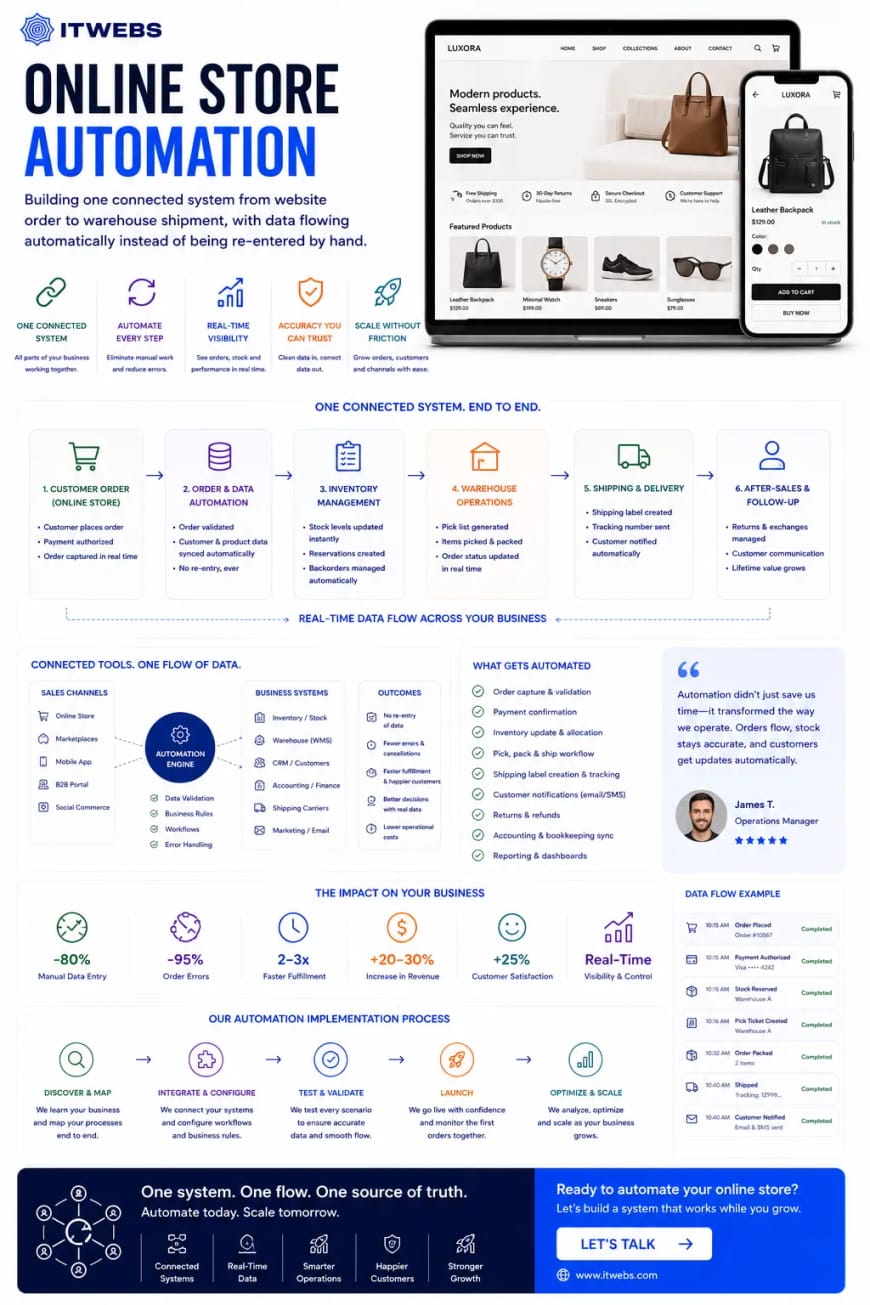
- Analysis and architecture design. We define the high-load core and the API layer for mobile apps and PWA.
- Phased development. We launch an MVP with the minimum feature set needed for sales, then add new modules step by step.
- Migration. We move customer, order, and product data carefully while preserving SEO positions.
Section 4: Cost and Timeline, the Honest Conversation
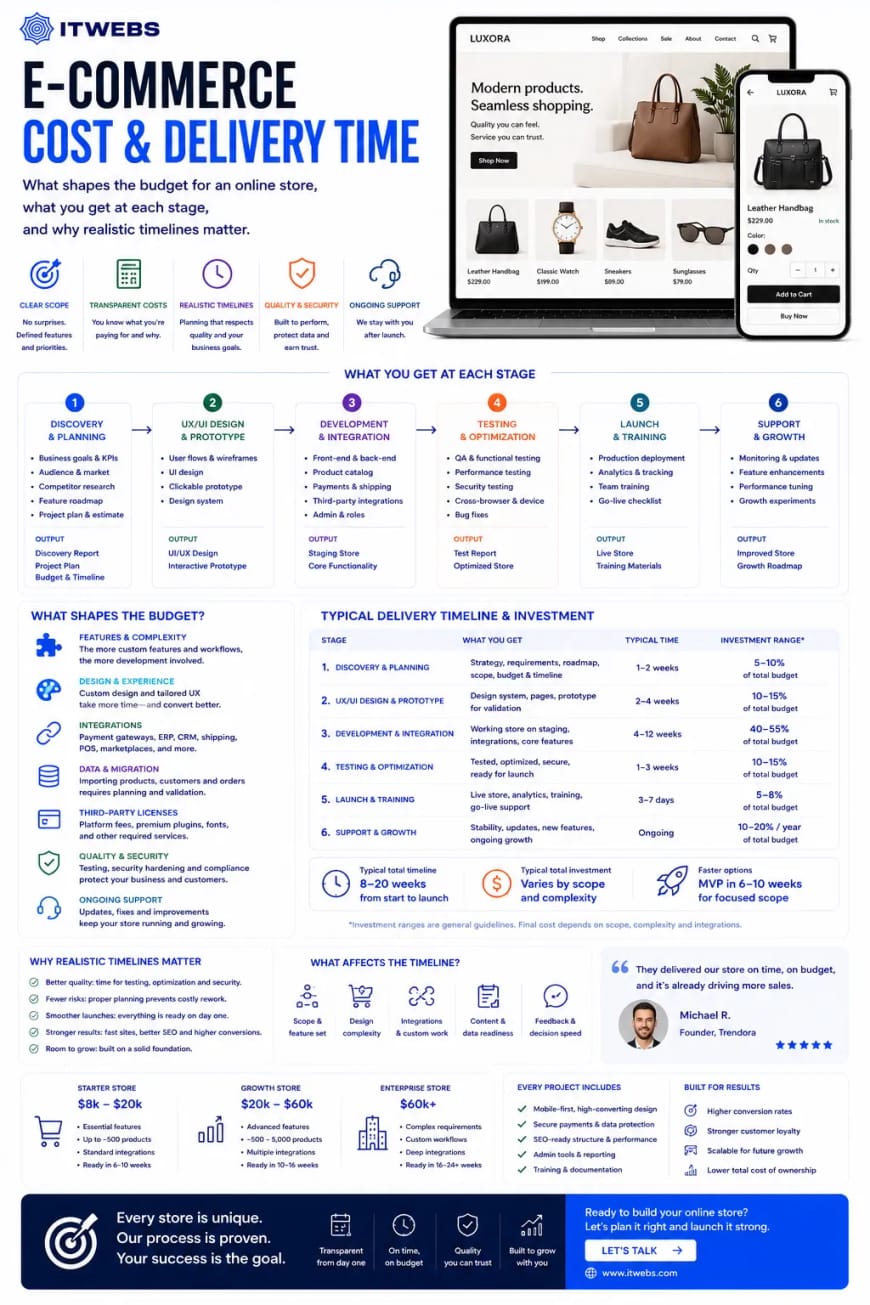
Yes, a custom store costs more than a starter template, with MVP projects starting from around RUB 1.5 million and three months of work. But 18-24 months later, you are far less likely to face a full rebuild. The savings in scaling and the absence of endless plugin subscription costs often make up the difference.
Conclusion: Your Store Should Reflect the Uniqueness of Your Business
Do not force it into generic logic. Custom development is an investment in long-term e-commerce growth.
Planning to scale your online store? Come to a free consultation with our architect, and let us discuss your case.