



Online Store SEO Foundation Guide
SEO for an Online Store: How We Build the Foundation for Organic Traffic from Day One explains why search optimisation should be part of ecommerce planning before design and development begin. This guide covers strategy, planning, examples, benefits, common mistakes and best practices for building organic visibility into store structure, category logic, product pages and content. You will learn how ecommerce website development, online store SEO and ecommerce automation work together to improve indexing, reduce technical barriers and support long-term traffic, conversion and sales growth.
Introduction: Pay for Clicks Forever or Build Organic Traffic?
Paid search keeps getting more expensive and the auction is increasingly aggressive. Without SEO, an online store is condemned to permanent acquisition costs. We build SEO into the product not after launch, but right at the prototype stage. Here is how.
Section 1: Semantic Core for E-commerce, More Than Just Keywords
For an online catalogue, it is important to separate product pages, category pages, and filters. We build the semantic structure around:
- Category intent such as "buy sofa" or "straight sofa," which maps to category pages.
- Product-level intent such as a product name or SKU, which maps to product pages.
- Informational intent such as "how to choose a sofa," which maps to blog content.
Every page is optimised for its own intent cluster, without overlap. Filter pages are protected from indexing using canonical logic.
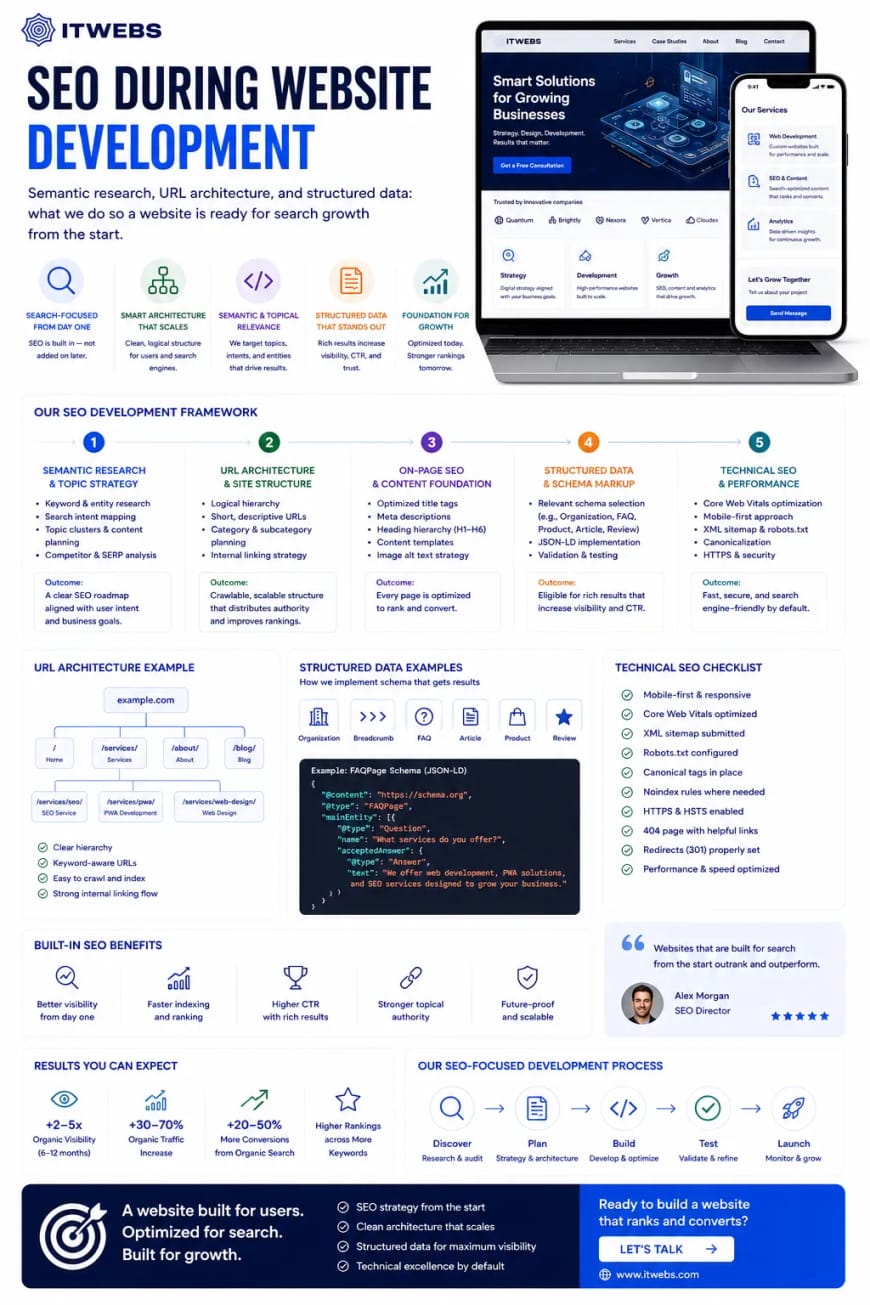
Section 2: The Technical Foundation That Impacts Rankings
- Clean URLs and breadcrumbs. For example,
site.com/catalog/sofas/straightplus Schema.org BreadcrumbList. - Product structured data. Price, availability, description, and rating are delivered through JSON-LD, enabling richer snippets in search with price and stars.
- Catalogue speed. Deferred image loading, caching, and CDN support are built in.
Section 3: The Content Strategy for an Online Store
Every category and product page should contain unique content that answers the customer's question. Product pages need descriptions, specifications, and reviews. Category pages need overviews and comparisons. None of this is written for decoration. It is driven by search intent taken directly from the semantic model.
Section 4: Growth Example, How a Pet Store Reached 50,000 Visits per Month
At launch, we applied our methodology from scratch: correct catalogue structure, product markup, and a useful blog. After eight months, organic traffic reached 50,000 visits per month, and 60% of all sales were coming from search without a single rouble spent on ads.
Conclusion: SEO for Online Stores Is Not About "Writing Some Text," It Is Technical and Content Integration
And it starts at the same time as the first line of code.
Launching an online store? Order a free SEO audit of the prototype. We will identify critical issues before they ever reach production.